

The development of cutting-edge technologies is transforming our lives, and we often don’t even notice how artificial intelligence is becoming an indispensable assistant in various fields.
We turn to ChatGPT for advice, create masks and filters on Instagram, see images on social media generated by AI, choose products in stores whose ads were crafted by AI, and even listen to music or watch videos created with the help of artificial intelligence.
Sports are also a part of our lives and are not immune to progress, so artificial intelligence in sports is no longer a distant prospect but a present-day reality.
Various AI-powered programs can act as your invisible coach, analyst, or assistant in creating a competitive look.
USPORT explores how artificial intelligence is already being used in sports and what future opportunities lie ahead.
What is Artificial Intelligence?
Simply put, artificial intelligence is a set of programs, algorithms, or technological tools that use large amounts of data to provide us with answers, predictions, or recommendations.
The primary goal of AI is to make human tasks easier, as it can analyze and process information much faster than a person. AI takes in large data, analyzes it, and creates something new based on the processed information.
There are two main types of artificial intelligence: predictive and generative. Predictive AI delivers results based on existing data, while generative AI creates new content.
For What AI in Sports?

In professional sports, every detail matters when it comes to achieving results or victory. The difference between winning and losing can be mere millimeters or fractions of a second. Artificial intelligence can analyze data to create better training plans, recovery processes, and game strategies, ultimately improving performance.
But AI in sports benefits more than athletes. It also benefits referees, competition organizers, and broadcasters. In this article, we’ll explore exactly how, with real-life examples of how artificial intelligence is being used in sports.
AI Usage in a Training Process
Athletes likely have the broadest range of opportunities for using artificial intelligence.
Artificial Intelligence in Football
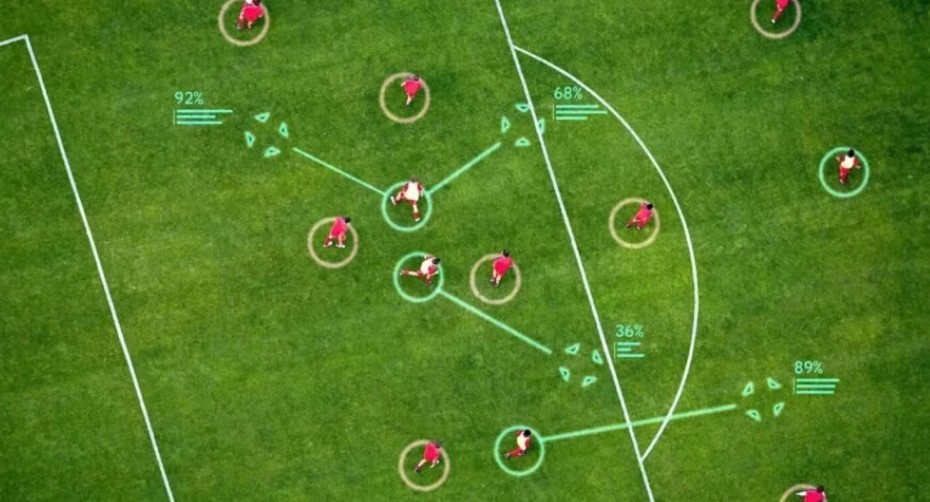
First, AI offers the ability to improve performance through smarter training. Every detail counts, and for example, DeepMind—owned by Google—introduced an AI-powered system called TacticAI last year. Developed through years of collaboration with Liverpool Football Club, TacticAI can suggest strategies for corner kicks, player positioning, and tactical adjustments. Similar systems can be applied to virtually every aspect of the game.
It’s also known that FC Barcelona uses artificial intelligence to fine-tune strategies and maximize on-field performance.
Artificial Intelligence in Match Broadcasting
NBA teams typically don’t disclose their partnerships with AI developers. Still, earlier this year, researcher Rajiv Maheswaran revealed that all 30 teams, to varying degrees of success, are using artificial intelligence in their training processes. Teams like Houston, Golden State, and Oklahoma City were among the pioneers, adopting AI-based training programs as early as the 2010s.
According to Maheswaran, AI helped one team select the optimal defensive strategy a few years ago, eventually leading them to win the championship. You don’t have to look far for a current example: The Oklahoma City Thunder won the Western Conference this year. As Dean Oliver, founder of the ESPN Analytics Group, noted:
“They played differently. They forced opponents into turnovers while minimizing their own. That gave them a clear advantage.”
Sports analyst and consultant Ben Alamar told Forbes that artificial intelligence won’t turn a weak team into a champion. Still, for a team capable of winning 50 games in a season, AI might help push that to 55 or 56 wins.
In February, the NBA shared footage on social media showing the Golden State Warriors using AI in their training sessions. One clip featured a robot assisting Stephen Curry by collecting balls after his shots.
Artificial Intelligence in Diving
China is highly advanced in using artificial intelligence in sports. For example, before the Paris 2024 Olympic Games, Chinese tech giant Baidu developed a training system for divers. The system enables real-time video capture and instant analysis of dives during training, allowing athletes to refine their technique with immediate feedback.
“Diving involves performing complex movements in just 1.8 seconds—from take-off to water entry. The AI system allows for rapid playback and analysis. I use it to improve my technique. It breaks down the fine details of movement, helping me master the nuances of timing and entry control,”
shared Quan Hongchan, who won Olympic gold in synchronized 10m platform diving at Paris 2024.



Overall, artificial intelligence acts as a coach’s assistant. It helps reduce the number of videos coaches need to review, speeds up analysis, and highlights key performance indicators for tactical sessions.
A key advantage is AI’s ability to monitor athlete condition, predict injury risks or performance drops, and adjust training plans or player rotation in team sports accordingly.
Using AI to Improve Technique and Equipment
Leading sports equipment manufacturers have also embraced artificial intelligence.
For example, Wilson developed an AI-powered tennis racket that helps players enhance their technique by increasing power and accuracy in their shots. Adidas created a football that adjusts its flight path for optimal precision.
It’s likely that sports gear will be mass-produced soon with personalized features tailored to individual athletes, boosting overall performance.
Artificial Intelligence in Formula 1
Unsurprisingly, one of the most technologically advanced sports—Formula 1—is advancing AI adoption. Teams use AI to improve car simulations, while Red Bull is leveraging AI to help develop sustainable fuel for its upcoming Red Bull Powertrains, set to debut in 2026.
This season, Red Bull also began using AI to prepare official protests by quickly analyzing FIA regulations and historical precedents.
Using Artificial Intelligence in Sports for Recruitment and Roster Decisions
Back to the NBA, which widely embraces AI, another key area is scouting and roster building. Teams can input specific parameters before the draft or when exploring trade opportunities to identify players who best fit their playing style or system.
With predictive modeling, AI can highlight players likely to progress significantly in the upcoming season, providing valuable insights for trades and contract decisions.
And it’s not just the NBA. For example, Major League Baseball (MLB) uses AI to support teams in making smarter roster and lineup decisions.
Using Artificial Intelligence in Sports Officiating
One of the most promising areas for AI in sports is officiating, where subjective judgments often lead to controversy during major competitions.
Progress is already being made. For example, the Japanese Judging Support System (JSS), developed by Fujitsu in collaboration with the International Gymnastics Federation, analyzes gymnasts’ movements in 3D to assist judges with accurate scoring.
In the NBA, AI improves foul detection, while in the NHL, it helps verify the legitimacy of goals.
God with a discount. Is it fine for Lionel Messi to be only worth 30 million euros?
Even in boxing, artificial intelligence has been tested in officiating. This happened in December 2024 during the high-profile bout between Ukrainian champion Oleksandr Usyk and Britain’s Tyson Fury.
The AI system tracked the effectiveness, aggression, and defense of punches landed, gathering real-time metrics throughout the fight. While the official judges scored the fight 116–112 in favor of Usyk, the AI scored it 118–112 for the Ukrainian.
Artificial Intelligence for Fan Experience and Broadcast Enhancement
Another promising area for AI in sports is enhancing the viewing experience on-screen and in stadiums.
During Euro 2024, the BBC used OptaAI (by Stats Perform) to deliver new layers of real-time analytics and improve broadcast storytelling. AI-powered cameras are now used to automatically film matches, while AI software identifies and highlights key moments during games.
Advanced real-time stats make watching sports more engaging and accessible. For example, La Liga partnered with Microsoft to launch the Beyond Stats project, adding interactive graphics and tactical insights to match broadcasts.
Beyond xG data and player heat maps, the system can show detailed movement paths of players in key moments and break down critical goals. Each La Liga stadium has 16 fixed cameras and 3.5 million tracking points per venue. Powerful servers process the footage in real time.

Artificial Intelligence in Animated Sports Broadcasts
AI is also opening new possibilities for how games are visualized. In November, Disney, ESPN, and the NBA introduced “Dunk the Halls”—the first real-time animated NBA game.
During the matchup between the New York Knicks and the San Antonio Spurs, AI captured live player movements and actions, transforming each athlete into an animated character, such as Mickey Mouse, Donald Duck, Goofy, Chip, and Dale.
Thanks to real-time visualization technology developed by Sony’s Beyond Sports, fans could watch the game as a fully animated experience.
Artificial Intelligence in Biathlon
Last season, the International Biathlon Union (IBU) began using an AI-powered camera system at the shooting range. This ensured complete coverage of all 30 shooting lanes, allowing national broadcasters to feature their athletes during live broadcasts.
Artificial Intelligence at the 2024 Olympic Games
For the Paris 2024 Olympics, local company Mistral AI developed a chatbot that browsed thousands of informational pages and answered any question 24/7. The bot helped users navigate Olympic venues, provided instant responses for social media, and clarified rules of conduct at the Games and in the Olympic Village.
Many clubs already use AI-based systems to simplify stadium navigation, helping fans easily find seats, grab snacks, or locate restrooms. Interestingly, La Liga uses AI in Spain to generate the “ideal” match schedule by analyzing historical data to boost attendance and maximize TV viewership.
Is It All That Great?
Many successful examples of AI use in sports exist, but is everything perfect?
It’s important to remember that AI only works effectively when it can access large volumes of data. Without sufficient input, its full potential remains untapped. Another issue is cost—these systems are often expensive and affordable only for top-tier clubs, potentially widening the gap between wealthy and less-resourced teams or athletes.
There are ongoing debates about data privacy, and concerns that AI could make sports feel overly mechanical, reducing the human emotion and unpredictability that fans love. Many people are also skeptical or resistant to AI, fearing that it could threaten jobs within the sports industry.
The Irreplaceable Human Factor
The human factor is essential in sports. Countless unpredictable variables cannot be fully controlled, meaning AI can’t consistently deliver reliable results.
For example, a missile strike in a Ukrainian town during the night could profoundly affect the mindset of an athlete whose family lives there. A coach would understand and support their athlete emotionally—an AI system wouldn’t.
In England, AI was tested to improve VAR decisions, but it took over 8 minutes to make a call in one controversial incident. Eventually, the system was abandoned due to inefficiency.
NBA European League: A New Chapter in a Long-Running War in European Basketball
Big Data ≠ Always the Right Answer
Processing large volumes of data doesn’t always lead to the right solution. One non-sports example illustrates this well: when an AI system was asked how to prevent train accidents, it responded that the best solution was to prevent trains from leaving the station.
In February this year, an experiment was conducted in Norway, in which artificial intelligence was used as a head coach for a sports team.
The System Failed
At first, the AI coach instructed its team to play in a 4-5-1 formation, and they even scored the opening goal. But then, the system malfunctioned.
The robot began giving irrational commands—telling all players to chase the ball immediately and instructing the goalkeeper to take throw-ins. As a result, the AI-led team lost the match 1–6.
While artificial intelligence in sports is still in its early stages, its presence is rapidly expanding—from performance analytics and injury prevention to officiating and fan engagement. AI is already transforming how athletes train, teams make decisions, and fans experience the game.
Despite limitations—such as data dependency, high costs, and the irreplaceable human element—AI holds tremendous promise. It is not here to replace people, but to enhance decision-making, increase efficiency, and unlock new possibilities across all levels of sport.
As AI technology evolves, the sports industry will undoubtedly continue discovering innovative and powerful ways to apply it, reshaping the future of competition, coaching, and entertainment.